Mount Meru Climb
6 days / 5 nights
Mount Meru Climb is the best for acclimatization prior to Mount Kilimanjaro climbing; The Mountain is the third highest peak in Africa and is the second highest mountain in Tanzania at 4,566 mt.
Upon arrival at Kilimanjaro airport you will be met by our representative and taken to Keys Hotel. It is a family run hotel located on the slopes of Mount Kilimanjaro, with comfortable accommodation, variety of meals, clean swimming pool and friendly services. Located just ten minutes walking distance to Moshi town center, palatable meal and luxurious accommodation;
Keys Hotel is the most spectacular place one will always wish to stay, Keys Hotel - 2700 ft (BB).
Momella Gate (1,500 m/4,920 ft) – Miriakamba Huts (2,515 m/8,250 ft)
• Walking distance: 10 km
• Walking time: 4-7 hours
• Altitude gain: 1,015 m/3,330 ft
Having almost caught up on our sleep, we depart the Keys Hotel for our first challenge, an ascent of Mount Meru. Although smaller than Kilimanjaro, it is not to be underestimated! Our walk begins after drive to the park gate and we head for Mirikamba Hut. We’ll find ourselves walking through the Arusha National Park with a view across the plains of Africa behind us and, in front, a fantastic view of Mount Meru. Giraffes, buffalo and monkeys are a regular sight here. As you ascend, the forest gets deeper and the track winds through it with interest. The walk takes around 3 hours, leaving time to take in the views and the huts provide dormitory type accommodation.
Dinner and Overnight: Miriakamba Huts - (FB)
Miriakamba Huts (2,515 m/8,250 ft) – Saddle Huts (3,570 m/11,710 ft)
• Walking distance: 8 km
• Walking time: 3-5 hours
• Altitude gain: 1,055 m/3,460 ft
After a full breakfast with a great view of Kilimanjaro to the east, it is time to trek up to the Saddle on Mount Meru. The vegetation starts to change as height is gained; we emerge from the forest and eventually arrive at Saddle Hut. It is time for lunch, followed by a short ascending on Little Meru in the afternoon for extra acclimatization. After soaking up the view its back to the Saddle Hut to prepare for our first big day, Meru summit. It is important to get some sleep at this point, which is sometimes easier than to be done during the early hours.
Dinner and Overnight: Saddle Huts - (FB)
Saddle Huts (3,570 m/11,710 ft) – Summit (4,566 m/14,980 ft) - Miriakamba (2,515 m/8,250 ft)
• Walking distance: 18 km
• Walking time: 10 hours
• Altitude gain: 996 m/3,270 ft
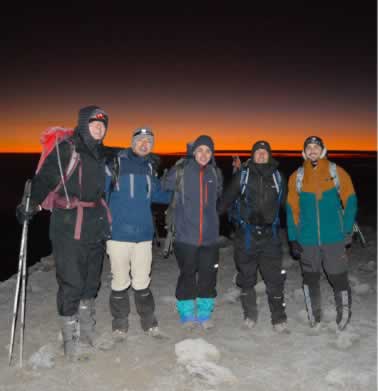
An exciting day today as we wake at midnight for an early breakfast. Our climb begins under a blanket of stars and we eventually reach our first milestone, Rhino Point. After a short descending and a steady scramble over sloping slabs, it is now uphill all the way to the summit. The route sees us climb the remaining part of the crater wall that surrounds the ash cone in the centre of the volcano. As we get close to the top the sun breaks the horizon and bathes everything in a warm orange glow. The final rocky stretch leads to the summit and we are rewarded with a view of our surroundings, including Kilimanjaro to the east. It takes 8 - 10 hours to reach the summit where the photographing opportunities are not to be missed. It is now time to descend to Mirikamba Hut to rest and relax after a long climb.
Dinner and Overnight: Miriakamba Hut - (FB)
Miriakamba (2,515 m/8,250 ft) – Momella Gate (1,500 m/4,920 ft)
• Walking distance: 10 km
• Walking time: 2-4 hours
• Descend: 1,015 m/3,330 ft
Today is a relaxing walk to the gate. We make an early start so we can take our time to see as much wildlife on the way as possible. We take a slightly different route down as we came up on the first day. This allows us to see some picturesque waterfalls. Finally, we drive back to Keys hotel for a well-deserved hot shower.
Departure
Frequently Asked Questions
What is the best time of year for trekking?
The best time is during the dry seasons: December to March and June to October.
What is the difficulty level of the trek?
Kilimanjaro is challenging, while Meru is moderate; both require good physical fitness.
What is included in the package price?
Accommodation, meals, park fees, guides, porters, and transportation are typically included.
Do I need a special permit to trek?
Yes, permits are required and are usually included in the package.
What type of accommodation will be provided?
Camping for Kilimanjaro and huts or lodges for Meru.
What should I pack for the trek?
Pack warm clothing, sturdy boots, a sleeping bag, trekking poles, and personal items.
What happens in case of an emergency?
Guides are trained for emergencies, and evacuation procedures are in place.
What fitness level is required for this trek?
A good fitness level with prior trekking experience is recommended.
Can I customize the itinerary?
Yes, itineraries can often be customized to suit your preferences.
Are there any age restrictions for activities?
Generally, the minimum age is 10-12 years, with no strict upper limit, depending on health.
What is your cancellation policy?
Cancellation policies vary, but typically refunds depend on how far in advance the cancellation is made.
Our Vision
We are creating amazing experiences for all in the nicest possible way. Our joy, is to see our customers served to their maximum satisfaction.
Why Choose Us?

Experience the Best of Tanzania
At Safari Adventures, we specialize in creating custom, boutique safaris that provide the perfect blend of adventure, luxury, and cultural immersion.
Tailor-Made Itineraries
Customized plans to fit your interests, time, and budget.
Luxury and Comfort
Exclusive-use camps with gourmet dining and top-tier amenities. Selection of hotels and lodges ideal to suit our customer’s needs.
Expert Local Guides
Knowledgeable guides with experience.
Special Program for People with Special Needs
We have developed a specific program which is designated to cater for the needs of the people with special needs.
Top-Quality Vehicles
Well-maintained 4×4 vehicles for a safe and comfortable safari experience.
Value for Money
Our itineraries are designed to provide the best experiences at a reasonable cost.
Sustainable tourism
We are glad to be engaged with responsible tourism and we go extra mile to facilitate more impactful responsible, sustainable, exiting and memorable explorations for our customers.
Best Time to Travel for a Tanzania Safari
The ideal time to visit Tanzania is during the Dry season, from late June to October, offering the best wildlife viewing opportunities. The wildebeest migration in the Serengeti typically occurs from July to September, while the calving season is from late January to February. The southern and western circuit parks are best visited during the Dry season (June to October), whereas the northern circuit parks can be enjoyed year-round.
Follow us on Social Media